LinkConnector Validation

A Genealogist In The Archives

Thursday, December 28, 2023

Preserving Christmas Ornaments

Christmas 2023 is over! Many of us are going to start taking down our Christmas trees like we do every year. Are you paying attention to how you are storing your Christmas ornaments, especially the ones that are very old, family heirlooms or just special to you? It's easy to pack up your ornaments and store them in such a way they are preserved and archivally safe.


Unwrapping Christmas ornaments and placing them strategically on the tree so that we don't leave any holes. Many of these ornaments bring back so many memories. Handmade ornaments made by my daughter when she was growing up. Christmas ornaments that I inherited from my Grandmother after her passing, they remind me that she always had one of those silver metal trees. And ornaments that my husband and I purchased at monumental times in our married life like the one that says "Our First Christmas".


As a county archivist, I work every day to archive and preserve my county's historical records. Using the right archival materials like file folders, boxes, tissue paper, etc. to make sure these records, ephemera and artifacts are preserved for future researchers.

Preserving our families precious and one-of-a-kind Christmas ornaments is something that I find most genealogists don't think about, not like they do their genealogical documents. The fact is, these handmade ornaments have meaning and tell a story just like our family documents do. Preserving these ornaments properly is something that any genealogist can do quite easily.

Archival Items You Will Need:

Archival Tissue Paper, to wrap handmade and unique ornaments with for protection
You can purchase archival tissue paper at Gaylord Archival at this link
https://shorturl.at/lqwxD


Archival Divided Compartment Box, to store the wrapped ornaments
You can purchase an archival ornament storage box at Gaylord Archival at this link


Wrap up each ornament very carefully in the tissue paper and then lay them in the compartments in the archival box. If needed, crumple up additional tissue paper and put around the wrapped ornament so that it won't move around in the box.

Store these ornaments in a cool, dry and dark place. Do not store in an an attic, basement or in direct sunlight. It might be a good idea to put these family ornaments where genealogical records are stored since they are considered family artifacts.

So, as you are taking your Christmas down this year and you are seeing the handmade and unique family ornaments, think about preserving them like I have discussed instead of putting them back in the garage or attic where they could be deteriorating.


REMEMBER: IT'S NOT ALL ONLINE, CONTACT OR VISIT AND ARCHIVE TODAY!

*****

Scrapbooks! Want to know how to find them in archives? Or learn how to preserve the ones you own?

Get My Legacy Family Tree Webinar

Scrapbooks: A Genealogist's Gold Mine

http://legacy.familytreewebinars.com/?aid=1161 


Wednesday, September 20, 2023

Surprises Behind Those Framed Photos

Many of us have inherited framed photographs or documents as part of our family genealogy collections. In the Houston County, TN. Archives & Museum, we sometimes receive framed photographs and documents as part of a records donation.


Many of these framed photographs and documents are in frames that have removable backs. This way the photographs and documents can be changed out if the person wanted to display a different photo or document. My Grandmother, Ida Kathryn (Drummond) Bartram (1922-2012), had framed photographs of all her grandchildren's school pictures and each year she would put the newest photo in the front to be displayed.


Frame with Removable Back


Frame with Removable Back


If you have received framed photographs or documents with removable backs, have you taken the back off to see what secrets could be hiding? A few years ago, I inherited some framed photographs from my Aunt and I found that there was a different photograph hiding behind the one that was showing.

The photograph that was on display was of my Great Grandfather:

William Sherman Bartram (1872-1961)

The photograph that I found, in the same frame, hiding behind the William Sherman Bartram photo was of my other Great-Grandparents:

Alva Filmore and Mary (Baker) Drummond

The interesting thing about these two photographs is they are from two different families that are both related to my late Aunt and myself.

One of the first things we do in the archives when we have received framed photographs or documents that have removable backs is to remove the back and see if there are any additional hidden documents or photographs that can't be seen from the front.

It is surprising how many people will put more than one photograph or document in a single picture frame. Then, over time, those older photographs and documents are forgotten. There has been many times when people have found long lost photographs and documents in picture frames of their family.

Some might remember back in 1991 when someone purchased a $4.00 painting at a flea market and when the frame was taken apart an original copy of the Declaration of Independence was found which was estimated to be worth $800,000.00 to 1 million dollars at the time. You can read about this event here:

https://mymodernmet.com/declaration-of-independence-found/


While we may not find an original copy of the Declaration of Independence behind one of our ancestor's photos, it is still a good idea to check those framed photos and documents for anything that might be hiding!

REMEMBER: IT'S NOT ALL ONLINE, CONTACT OR VISIT AN ARCHIVE TODAY!!

****

Get My Legacy Family Tree QuickGuide for just $2.95 and Available for Immediate Download!

Scrapbooks: A Genealogist's Gold Mine


Wednesday, March 1, 2023

Preserving Your Family Scrapbooks

Scrapbooks are a genealogists gold mine! If you ask anyone that knows me, they will tell you that my favorite record collection to do research in and to process in the archive is Scrapbooks!

Scrapbooks are like time capsules, nobody knows what will be found in them until they are opened. There are all kinds and styles of scrapbooks from newspaper clippings, obituary, diary, sports teams, personal history and many more.

Donated Scrapbooks, Houston County, TN. Archives & Museum

Maybe you have inherited scrapbooks from family members. Are they falling apart? Are the contents falling out? Scrapbooks are usually one of those record sources that are handled a lot over time because they are so interesting.

Preserving scrapbooks is actually fairly easy and any home archivist can do it. Here are 5 easy steps:

1. Digitize each and every page of the scrapbook. You can use a flat bed scanner or you can use your digital camera. Do not use any kind of self-feeding scanner or a hand held scanner, they can potentially damage the pages or the items pasted to the pages. Make sure to digitize the scrapbook in original order from the first page to the last page.

2. Purchase archival tissue paper. Get a size that is about 1/4" to 1/2" larger than the scrapbook page. You want to make sure the tissue paper covers the entire page but there is not too much excess. You can cut the tissue paper to size if needed.

3. Interweave the tissue paper between each and every page of the scrapbook. The tissue paper will act as a shield to protect anything on the pages from bleeding onto or damaging the other page.

Archival Tissue Paper in the Scrapbook, Houston County, TN. Archives & Museum

4. Purchase an archival box that is as close to the size of the scrapbook as possible. Put the scrapbook in the box. If there is still room in the box and the scrapbook is sliding around, crumple up archival tissue paper and tuck it around the scrapbook to secure it in place so that it doesn't move.

Scrapbook in an Archival Box, Houston County, TN. Archives & Museum

5. Label the box with information about the scrapbook. For instance, "World War II Scrapbook, Belonged to John Jones, 1941-1945". Store in a cool, dry and dark place. Keep away from sunlight and handle the scrapbook as little as possible. Consult with the digital images as much as possible so that damage is not done to the original scrapbook.
    These 5 easy steps to preserve scrapbooks will insure they will survive for many years to come.

    I recently was a guest on Connie Knox's show Genealogy TV on YouTube. You can watch the episode where I took questions about scrapbooks and photo albums. Here is the link: https://www.youtube.com/watch?v=11wZOvuGtKs


    REMEMBER: IT'S NOT ALL ONLINE, CONTACT OR VISIT AN ARCHIVE TODAY!!

    **********

    Get More Information About Scrapbooks!

    Watch My Legacy Family Tree Webinar

    Scrapbooks: A Genealogists Gold Mine


    Get My Legacy Family Tree Quick Guide

    Scrapbooks: A Genealogist's Gold Mine

    PDF Version: http://legacy.familytreewebinars.com/?aid=1413

    Wednesday, February 22, 2023

    Black History Month: Julius Rosenwald and the Rosenwald Fund

    As my last blog post for Black History Month I want to talk about my favorite African American subject, the Rosenwald Fund. 

    1963 Graduating Class at the W.H. Hensley School
    Houston County, TN. Archives & Museum

    The Rosenwald Fund also known as the Julius Rosenwald Fund was established in 1917 by Julius Rosenwald and his family with a partnership with Booker T. Washington to build and support local African American schools in the south. Unlike other endowed foundations, which were designed to fund themselves in perpetuity, the Rosenwald Fund was designed to expend all of its funds for philanthropic purposes before a predetermined sunset date. The fund donated over $70 million to public schools, colleges and universities, museums, Jewish charities and African American institutions before funds were completely depleted in 1948.

    Julius Rosenwald and Booker T. Washington
    Photo Courtesy of Special Collections Research Center, University of Chicago Library

    One of the more well known projects was providing funds to local school boards to build African American schools. Over 5,000 schools were built in the states of Florida, Georgia, Alabama, Mississippi, Tennessee, Kentucky, Louisiana, Arkansas, Texas, Oklahoma, North Carolina, South Carolina, Missouri, Virginia and West Virginia.

    Rosenwald Fund Schoolhouse Construction Map, 1928
    Courtesy of North Carolina Digital Collections

    In Houston County, Tennessee, where I am the archivist at the Houston County Archives & Museum, we have uncovered documents, photos and information about an African American school we had locally that was funded by the Julius Rosenwald Fund. The W.H. Hensley School was built with funds from the Rosenwald Fund. This fund also provided funds for books and other supplies. While the school building itself no longer exists, the history of this school is being documented so that it is not forgotten.

    W.H. Hensley School, Houston County, Tennessee
    Houston County, Tennessee Archives & Museum

    If you think your African American ancestors attended a Julius Rosenwald funded school, check with the local historical or genealogical society and see if they have any information, documents or photos. Many of these school buildings still exist and have historical markers placed to honor the work Julius Rosenwald and Booker T. Washington accomplished.

    Courtesy North Carolina Department of Cultural Resources

    We should be researching all aspects of our families ancestry, including the schools they attended!

    ***********************************************************************************

    Want To Know More About Researching in School Records?

    Watch my Legacy Family Tree Webinar

    The ABC's and 123's of Researching Your Ancestor's School Records

    http://legacy.familytreewebinars.com/?aid=3076 


    Wednesday, February 8, 2023

    Black History Month: Finding Lucy

    February is Black History Month and all month long my blog posts will be about researching African American ancestors. 

    I was very excited to see that my local news station WSMV-Nashville Channel 4 is doing a series of stories during Black History Month highlighting African American history and genealogy. Their first story really interested me as a genealogist and as an archivist. 


    1859 Ambrotype Photograph of 9-Year Old Lucy Waggoner


    Marius Payton, one of the WSMV news anchors ran across an ambrotype photograph of a little 9-year old girl named Lucy in an issue of the Tennessee State Museum Magazine. This photograph is dated 1859 and Lucy was enslaved with the Waggoner family in Davidson County, Tennessee. Marius reached out to the Afro-American Historical Genealogical Society (AAHGS) to help him research the history of this little girl. The AAHGS website is at this link: https://www.aahgs.org/


    I will not recount the remainder of the story here in my blog, you can watch the video of what researchers found at this link: https://www.wsmv.com/2023/02/04/finding-lucy-obstacles-searching-descendants-slaves/ fbclid=IwAR2ErrM5aIs0F4Y6o2XctPvdHimC0ZaEOHA3nNJxZAxfDlTEqSc5qwuXW1A

    Researching African American genealogy can be a daunting task, especially once you get back before 1870. But do not let that deter you from researching your black history. Many archives have records, photographs and artifacts that could help you. February is the time to be on the look out for these archives to share what they have as we celebrate the lives and history of African Americans. 

    Maybe you have a story like Lucy Waggoner, I would encourage you to not give up and to keep searching for the answers. Everyone who ever lived on planet Earth has a story to tell and we as genealogists need to be telling that story so it is not forgotten.


    ***********************************************************************************

    Get My Legacy QuickGuide

    Family Gatherings: Dragging Genealogy Information Out of Your Family


    Saturday, February 4, 2023

    Book Review: Revolutionary Roads by Bob Thompson

    Revolutionary Roads: Searching for the War That Made America Independent and All the Places it Could Have Gone Terribly Wrong by Bob Thompson. Published by Twelve Books: 1290 Avenue of the Americas, New York, NY. 10104; https://www.twelvebooks.com/; 2023. ISBN 978-1-4555-6515-3. 448 pp. Bibliography, illustrations, index, notes. Hardback. $32.00.


    Cover of Book, Courtesy of Twelve Books

    Bob Thompson’s new book Revolutionary Roads is a true adventure story. I am always telling genealogists to “walk in your ancestor's footsteps” and Thompson’s book is like going back in a time machine to experience the crucial places during the American Revolution. Many times, we can’t understand what our ancestors experienced, saw, and lived through unless we actually go there and see if for ourselves.

    Revolutionary Roads tour through many of the Revolutionary War sites makes for a great read. I found myself not wanting to stop reading and couldn’t wait to get to the next chapter. I was concerned that I would not be able to visualize the places the author visited but his writing kept me interested and I could really see the places he was describing. In addition, the reader gets a great dose of “what if” from Thompson as he talks about what could have happened if the war didn’t go just as it did.

    This book is an example for every genealogist to consider the events your ancestors experienced through their eyes as much as possible. Visiting those places, if they still exist, that had an impact on their lives, their decisions, their accomplishments, and their defeats can really add to your ancestor story.

    The author covers many of the lesser-known battles and incidents, which I really liked and was glad to see. I envisioned my ancestors that I know were living in the same areas or were involved with the Revolutionary War as I read this book. Thompson’s writing helped me to place my ancestors in those times and places and truly have more of an understanding of what they went through.

    I can highly recommend Bob Thompson’s Revolutionary Roads: Searching for the War That Made America Independent and All the Places it Could Have Gone Terribly Wrong to anyone wanting to know how to trace their ancestor’s footsteps and especially if you are like me and love reading about the Revolutionary War.


    Courtesy of Twelve Books


    ***********************************************************************************

    NEW! FREE MyHeritage Webinar by Melissa Barker

    MyHeritage: Your Personal Genealogy Archive

    Many of us are not able to travel to those places where our ancestors lived to do genealogy research. This should not deter us from finding information about our ancestors. MyHeritage can be your "home away from home" online archive to help you find information on your ancestors. Learn from a seasoned genealogist and archivist how to find archived records on MyHeritage from home.


    Wednesday, February 1, 2023

    Black History Month in the Archives

    February is Black History month and many of our local, state and national archives in the United States are gearing up for Black History Month programs, exhibits and displays. These archives will be sharing African American histories, documents, photographs and artifacts. 

    As the archivist for the Houston County, Tennessee Archives & Museum, I am very excited about celebrating the black history in my county and the entire United States.

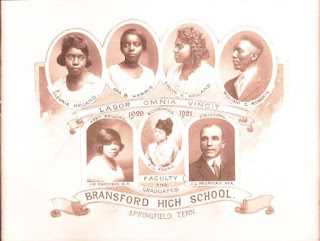
    Bransford High School Graduates, Tennessee State Library and Archives

    Many of our local, state and national archives take great pains in collecting, preserving and sharing their African American records with the public. Whether these records are Manuscript Collections, Photograph Collections, School Records or artifacts that directly relate to the history and lives of African Americans, they are extremely important to our over all world history.

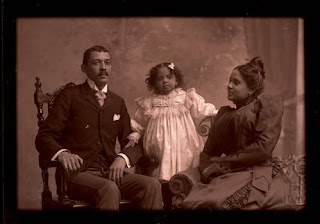
    Portrait of Henry W. Allen, Catherine B. Allen and Minta B. Allen, Tennessee State Library and Archives

    Black History Month is an annual celebration of achievements by African Americans and a time for recognizing their central role in U.S. history. Also known as African American History Monty, the event grew out of "Negro History Week", the brainchild of noted historian Carter G. Woodson in 1915 and other prominent African Americans. Since 1976, every U.S. president has officially designated the month of February as Black History Month. Other countries around the world, including Canada and the United Kingdom, also devote a month to celebrating Black history.


    If you have African American ancestors, I hope you take the month of February to celebrate their lives and tell their stories. Every person has a story to tell and if we as genealogists do not document and preserve our ancestors stories, they will be lost forever.

    ******

    Have Tennessee African American Ancestors?

    Check Out My Legacy Family Tree Webinar

    The Tennessee State Library and Archives: A Mega Archives for Your Tennessee Ancestors


    Tennessee State Library and Archives